
Empowering Businesses with Renewable Energy: The Ultimate Guide to Solar Panel Installation

Why Homeowners Should Consider Solar Panel Installation (2)

Empowering Businesses with Renewable Energy: The Ultimate Guide to Solar Panel Installation

In today’s competitive market, Businesses are under increasing pressure to adopt sustainable practices and reduce their environmental impact. Solar panel installation offers a practical solution, providing a renewable energy source that can significantly cut operational costs while promoting sustainability. InFlow Solar Co is at the forefront of this transition, offering cutting-edge solutions tailored to businesses’ unique needs. Here’s how embracing solar energy can transform your business.

Why Solar Panel Installation Makes Business Sense

  1. Reducing Operational Costs Solar panel installation allows businesses to harness the sun’s power to generate electricity, leading to substantial reductions in energy costs. With rising energy prices, companies can achieve long-term savings by investing in solar energy systems, making it a wise financial decision.
  2. Reliable Renewable Energy Solutions Solar energy is a dependable power source that can enhance your business operations. Solar power is not subject to price volatility and supply disruptions, unlike traditional energy sources. InFlow Solar Co provides robust and efficient solar solutions, ensuring your business’s consistent and reliable energy supply.

Sustainable Energy Options for a Brighter Future

  1. Enhancing Corporate Image and Responsibility Adopting sustainable energy options such as solar panels is a powerful way to enhance your company’s corporate social responsibility (CSR) profile. Customers, investors, and partners increasingly prefer associating with businesses committed to sustainability. By choosing InFlow Solar Co, your business can demonstrate a strong commitment to reducing its carbon footprint and supporting environmental initiatives.
  2. Leveraging Government Incentives The Australian government offers various incentives to encourage businesses to adopt renewable energy solutions. These include tax credits, rebates, and grants that can offset the initial solar panel installation costs. InFlow Solar Co can help you navigate these opportunities, ensuring you maximize the financial benefits of your investment.

Why Choose InFlow Solar Co for Your Solar Needs?

  1. Industry Expertise and Customized Solutions InFlow Solar Co is a leader in the solar industry, providing expert guidance and innovative solutions tailored to your business’s specific needs. Our team conducts comprehensive assessments to design and implement solar systems that optimize energy production and efficiency.
  2. End-to-end Service and Support From the initial consultation to installation and ongoing maintenance, InFlow Solar Co offers end-to-end services that ensure your solar panel system performs at its best. Our dedicated support team is always available to address issues and provide maintenance services, ensuring long-term reliability and performance.

Case Studies: Success Stories of Businesses Going Solar

  1. Retail Sector: A leading retail chain partnered with InFlow Solar Co to install solar panels across its stores. The result was a significant reduction in energy costs and an enhanced brand image as a sustainable business leader.
  2. Manufacturing Industry A manufacturing company faced high energy costs due to extensive machinery usage. By installing solar panels with InFlow Solar Co, the company achieved substantial energy savings and reduced its carbon footprint, meeting financial and environmental goals.

Conclusion

Investing in solar panel installation is an environmentally responsible choice and a strategic business decision that can lead to substantial cost savings and operational efficiencies. InFlow Solar Co is dedicated to providing Australian businesses with top-tier renewable energy solutions and sustainable energy options. Join the growing number of companies that have switched to solar and reap the benefits of clean, reliable energy.

For more information on how InFlow Solar Co can help your business transition to solar power, contact us today or visit our website at (www.inflow.com.au)

Transform Your Home with Solar Energy: Why Homeowners Should Consider Solar Panel Installation

Why Homeowners Should Consider Solar Panel Installation

Transform Your Home with Solar Energy: Why Homeowners Should Consider Solar Panel Installation

As energy costs rise and environmental concerns grow, more Australian homeowners are turning to solar panel installation to power their homes. Solar energy offers a clean, sustainable, and cost-effective solution that benefits both your wallet and the planet. InFlow Solar Co is at the forefront of this green revolution, providing top-notch renewable energy solutions and sustainable energy options tailored for Australian homes. Here’s why you should consider making the switch to solar energy today.

Financial Benefits of Solar Panel Installation

We want you to be well-informed about the various advantages of adopting solar energy. Here are five compelling reasons to make the switch to solar power:

  1. Lower Your Electricity Bills

Solar panels significantly reduce your monthly electricity costs by allowing you to generate your own power.

  1. Decrease Dependence on the Conventional Energy Grid

By using solar energy, you become less reliant on traditional power sources, enhancing your energy independence.

  1. Environmentally Friendly Alternative

Solar energy is a cleaner, greener option compared to fossil fuels like coal and diesel, helping to reduce your carbon footprint.

  1. Cost Savings with Solar Power Systems

Investing in solar power systems now can lead to substantial financial savings in the long run.

  1. Quicker Payback Period

Solar energy systems often have a faster payback period compared to conventional energy systems, making them a smart financial investment.

  1. Increased Property Value

Homes equipped with solar panel systems often have higher property values. Potential buyers recognize the long-term savings and sustainability benefits, making your home more attractive in the market. InFlow Solar Co’s high-quality installations ensure that your investment adds significant value to your property.

Embracing Renewable Energy Solutions

  1. Dependable and Clean Energy Solar energy is a reliable and renewable energy source that reduces your dependence on fossil fuels. With a solar panel system from InFlow Solar Co, you can ensure a steady supply of clean energy for your home, mitigating the risks associated with energy price fluctuations and supply shortages.
  2. Government Incentives and Rebates The Australian government offers various incentives and rebates to encourage the adoption of renewable energy solutions. These financial benefits can significantly lower the initial costs of solar panel installation. InFlow Solar Co can help you navigate these incentives, ensuring you maximize your savings and make your transition to solar energy as affordable as possible.

Sustainable Energy Options for a Greener Future

  1. Reduce Your Carbon Footprint Switching to solar energy is a powerful way to reduce your carbon footprint. By harnessing the sun’s energy, you can significantly decrease your household’s greenhouse gas emissions. InFlow Solar Co’s sustainable energy options help you contribute to a cleaner, greener planet while enjoying the benefits of renewable energy.
  2. Energy Independence Installing a solar panel system gives you greater control over your energy usage and costs. With energy independence, you are less affected by external factors such as energy price hikes and power outages. InFlow Solar Co provides reliable solar solutions that ensure your home remains powered and efficient.

Conclusion

Investing in solar panel systems for your home is a smart decision that offers both financial and environmental benefits. By choosing InFlow Solar Co’s renewable energy solutions and sustainable energy options, you can enjoy lower energy bills, increased property value, and a reduced carbon footprint. Embrace the future of energy today and transform your home into a model of sustainability.

For more information on how InFlow Solar Co can help you transition to solar energy, contact us today or visit our website (www .inflow.com.au)

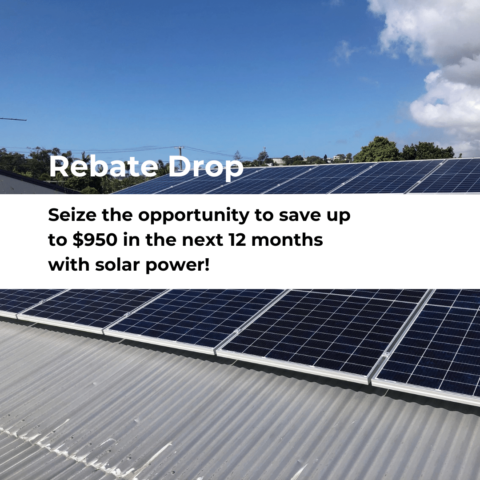
Seize the opportunity to save up to $950 in the next 12 months with solar power!

Rebate-drop

Seize the opportunity to save up to $950 in the next 12 months with solar power!

More Electricity Price Increases Coming in 2024

This year we experienced a rise in electricity prices up to 30%. Forecasts indicate another 17% increase in electricity prices next year. For an average home with 2023 electricity costs of $2,500, this could mean a jump to $,2925 with the increase.

Rebate Drop Alert

Every January 1st, solar power rebates decrease. Starting next year, a 6.6kW solar power system priced at $4,600 will cost around $4,950. Act now to save $350 on a 6.6kW system or $700 on a 13.3kW system before January 1st.

This time of year sees a surge in installations due to the rebate drop, leading to quickly filled schedules. I encourage you to make your decision in the next few weeks to secure your installation slot.

If you’ve been considering the switch to solar, now is the ideal time. Reach out today for your free proposal and take the first step towards substantial savings with solar power. Should you have any questions or if there’s anything we can do to assist with your electricity bill, please don’t hesitate to get in touch. We’re passionate about reducing energy usage and costs and are here to help. 

Simple tips to cut pool pump energy usage

Simple-Tips-to-Cut-Pool-Pump-Energy-Usage

Simple tips to cut pool pump energy usage

Ever thought about your pool pump’s energy appetite? A standard pool pump’s usage equates to about 20% to 30% of the average electricity bill (where a pool is present). Yep, that’s a chunk!

Your pool pump is like that friend who eats the most at the buffet. It’s one of the hungriest electricity eaters in your house.

But here’s the good news,  you can slim down that energy bill!

Here’s how:

  1. Invest in a variable speed pump

If you don’t already have one, a variable speed pump can save up to 70% of your existing pool pumps’ energy usage, when run at the lowest speed needed for health and cleanliness. Variable speed pump’s are reasonable investment but in the savings you will generally get your money back in 2-3 years. They are a stellar investment and don’t forget you can currently access a government rebate for any devices that reduce energy consumption. If you use that they are an even better option and might only cost you a few hundred dollars to save a hundreds of dollars per year.

  1. Keep it Clean

Regularly clean your skimmer and pump baskets, plus your pool filter. It eases the pump’s load and saves energy

  1. Robotic pool vacuum cleaner

Cleaning a big or debris-prone pool can be time-consuming. But with a robotic pool cleaner, you’ll save time and money on energy bills, as they work faster and use less electricity, than a creepy crawly attached to your pool pump. If you are thinking of a variable speed pump, a robot vacuum with its independent energy source, means you don’t have to be running your bigger energy hungry pump, in order to be cleaning debris from your pool.

These simple steps will help you dive into energy savings while keeping your pool sparkling.

Best Retailers for FIT and Energy Prices

Blog 7

Best Retailers for FIT and Energy Prices

Last July this year,  we experienced a significant increase in electricity prices up to 27%, for most retailers. Some retailers are still implementing a distributed increase up to December of this year, until 2024.

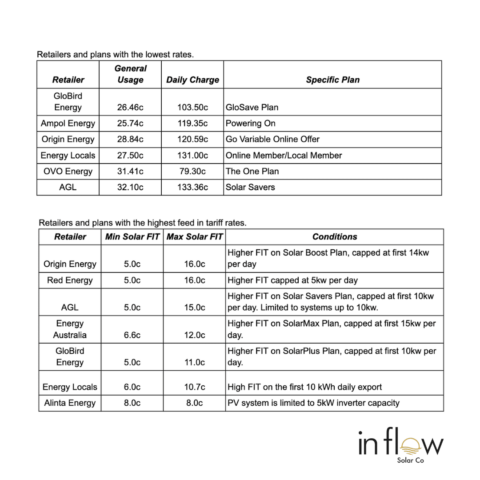
One option to avoid paying higher energy costs is choosing the best retailer and plan that fits your consumption and export. This means being charged with the lowest usage rate and paid with the highest feed in tariff rate. It is also helpful to have your electricity bill analysed so you will understand more about your consumption, export and rates. To help you, below are the updated electricity rates and FIT rates. 


Retailers and plans with the lowest rates.

Retailer

General Usage

Daily Charge

Specific Plan

GloBird Energy

26.46c

103.50c

GloSave Plan

Ampol Energy

25.74c

119.35c

Powering On

Origin Energy

28.84c

120.59c

Go Variable Online Offer

Energy Locals

27.50c

131.00c

Online Member/Local Member

OVO Energy

31.41c

79.30c

The One Plan

AGL

32.10c

133.36c

Solar Savers


Retailers and plans with the highest feed in tariff rates.

Retailer

Min Solar FIT

Max Solar FIT

Conditions

Origin Energy

5.0c

16.0c

Higher FIT on Solar Boost Plan, capped at first 14kw per day

Red Energy

5.0c

16.0c

Higher FIT capped at 5kw per day

AGL

5.0c

15.0c

Higher FIT on Solar Savers Plan, capped at first 10kw per day. Limited to systems up to 10kw.

Energy Australia

6.6c

12.0c

Higher FIT on SolarMax Plan, capped at first 15kw per day.

GloBird Energy

5.0c

11.0c

Higher FIT on SolarPlus Plan, capped at first 10kw per day.

Energy Locals

6.0c

10.7c

High FIT on the first 10 kWh daily export

Alinta Energy

8.0c

8.0c

PV system is limited to 5kW inverter capacity


Most retailers do not offer lock in, so you can always change again. Be extra careful also when talking to retailers. You should know what specific plan you want and make your own calculations. 

If you are receiving the 44c premium feed in tariff rate, there are retailers that pay over and above the 44c, you just have to meet their conditions to become eligible.

How much solar power will you need to charge an EV?

1

How much solar power will you need to charge an EV?

The main motivations to purchase an electric vehicle is for their fuel-saving abilities and environmental benefits.

On average, Australians drive 36 km per day. A standard EV can travel about 6.5km on 1kWh of battery charge. That means around 5.4 kWh is needed a day to charge the electric car from your solar panels.

Example for a Tesla Model 3 

1. How many kWh of electricity do you need to travel one kilometer?

Cars model

Battery capacity, kWh

Range, Km

Kwh / Km

Tesla model 3

75

500

0.15

You will need 0.15kWh per day for every kilometer drive. 

2. How many kWh you will need if you travel on average km daily (36km)? 

Cars model

Km / day

kWh / km

Total kWh per day

Tesla Model 3

36

0.15

5.4

You will need 5.4kWh per day to charge your electric vehicle.

3. How much solar power do you need to charge your electric car?

Cars model

Total kWh

Peak Sun hours / per day

Solar power system size, kW

Tesla Model 3

5.4

4.2

1.3

You will need 1.3 kw of solar daily to charge your electric vehicle.

4.

How much power does a solar system produce? 

  Solar system sizes and electricity production (average)

Size of solar panels system in kilowatts

Kilowatt hours of electricity produced per day

6.6kW

23.10kWh

10kW

42kWh

15kW

63kWh

In summary, if you are traveling  an average of 36 km per day, you will need 5.4kWh per day to charge your electric vehicle. This means you will be needing an additional 1.3kW solar power if you choose to charge it using solar during the day..

If you currently have solar, and 6.6kw system size. Let’s say you are using 9kWh for the household, during the day, and you are feeding 14kWh into the grid. You can now use that excess 14kWh to charge your EV if you charge it during the day. 

However, it would be different if you were to recharge it at night. For night time charging, you will be needing a battery so you can store some of  the 14kWh excess power and use it for night time charging.

This however applies to average travel distances. If you are traveling longer than 36 kms per day, let’s say 120 km per day, you will need 18kWh to charge your EV with solar. In this case, you may need  to upgrade your current system to meet your energy needs. Another 5kW of solar power would be required for enough energy to charge your vehicle during the day. 

What happens if you cannot charge through the day? 

Let’s say you work away from your home and you can only charge on the weekends. You will need enough solar power to potentially charge your car in two days. If you drive 36km per day you will need a system capable of providing for your home energy needs as well as another 27kWh for your EV.

What happens if you can’t charge your vehicle during daylight hours on  the weekends? 

Option A: For those of you with smart meters…Some retailers are starting to offer lower rates for charging during non peak hours for example midnight to 6 am

Option B: Another option maybe to store energy in a battery during the day to draw down at night.  The disadvantage of this option is the large capital outlay for the extra batteries, as well as the extra panels to generate the energy to be stored.

About Battery Backup when the grid goes down & Essential Circuits

2

About Battery Backup when the grid goes down & Essential Circuits

We all rely on electricity to power our homes. However, during unexpected power outages, having a battery backup can make a significant difference.

If you have the right battery storage system, when the grid goes down, your battery backup system kicks in to provide power to essential appliances. This ensures that crucial things like lighting, refrigeration, or heating and cooling remain operational when the lights go out, especially during nighttime outages.

When you have a battery installed, the installer will work with you to identify which appliances or circuits you want to prioritize during a power outage. This customization allows you to have power where you need it most when the grid goes down.

It’s essential to note that not all inverters can support this type of battery backup configuration. Also, of those that do, they vary in the amount of power that can be supplied in the event of a grid outage. Therefore, when considering a battery system, ensure it’s compatible with your specific needs and preferences.

Here’s how it works: During the day, the energy generated by your solar panels replenishes the energy used from your battery during the night.

In the event of an outage, your inverter will switch over to procide energy only to the back up or essential circuit of the home, as mentioned earlier. How long your home can last, will depend on what you are running on the backup circuit, how much energy those devces use and how much battery storage you have.

When the outage ends, your inverter will switch back over to the grid and again supply all the energy needs of your home.

Having a battery backup can bring peace of mind during power outages, making sure that essential functions in your home remain operational when you need them most. Working out the correct system and sizing to match your needs is imperative.


We are still offering FREE electricity bill savings checks!

We will analyse your bill for you, compare it with other retailers, and let you know who to change to and how much you will save! 

On average, you can save $200-$500 per year, but there are instances when you can save up to $700 or $800. It depends on your energy usage and how much you feed into the grid if you already have solar power.


How? Click here

Simple Ways to Save Energy on Heating and Cooling

3

Simple Ways to Save Energy on Heating and Cooling

Did you know that heating and cooling are the biggest energy hogs in the average Aussie home? On average, they can make up about 40% of your energy bill! But don’t sweat (or shiver) – we’ve got some simple tips to help you save energy and keep comfy.

Here’s how to cut down on heating and cooling costs:

  • Pick the right-sized heating or cooling gadget for your space. Don’t overdo it; you’ll waste energy.
  • Choose appliances that are energy-efficient. Look for the stars!
  • Use weather strips around doors and windows to keep the comfy air in and the outside air out. It’s like giving your home a warm or cool hug.
  • Install insulation in your walls and roof. It’s like putting a warm sweater on your house in winter and a sun hat in summer.
  • Thick curtains are like shields against the elements. They keep the heat out in summer and trap it in winter.

A few more tricks to keep in your back pocket:

  1. Set your thermostat to 18-20°C in winter and 24-27°C in summer. Every degree you go up or down can make a big difference.
  2. Put your thermostat in the rooms you use most and away from hot or cold spots.
  3. Only heat or cool the rooms you’re actually using. Close those doors!
  4. Keep windows and doors shut when your heater or air-con is running. Let the fresh air in when you need it.
  5. Close your curtains or blinds during the hottest part of the day in summer and chilly evenings in winter.
  6. Block drafts with door stoppers or sealant.
  7. Don’t leave your heating or cooling on overnight or when you’re out. Use a timer if you want a comfy house when you return.
  8. Don’t forget to service your heaters and coolers regularly. Clean those air filters for top-notch efficiency!

These simple steps will help you keep your home cozy while saving on your energy bills. Go ahead, give ’em a try!


We are still offering free electricity savings checks!

We will analyse your bill for you and compare with other retailers and let you know who to change to, and how much you will save! 

On average you can save $200-$500 per year, but there are instances that you can save up to $700 or $800, it depends on your energy usage and how much you feed into the grid, if you already have solar power.


How? Just click here

Should You Add a Battery Now?

Blog 7

Should You Add a Battery Now?

After working with some of our other clients…we have found that installing batteries isn’t all about economics. There are several more valuable motivations. So here are some questions you might like to ask yourself

1. What is your energy consumption and export

Do you export a lot of energy into the grid, that you could be storing in batteries to offset night use? 

If not, the first step might be to upgrade your solar power system so that you have considerable surplus energy. Having more solar generation than you need can have a couple of extra benefits;

  1. It can help you to produce more on cloudy or rainy days to continue to meet your homes energy usage
  2. It can help you to charge your batteries quicker, when you have them. More solar panel production = Faster charging. This will again particularly help on cloudy days when there is limited solar power being produced.

How much electricity are you utilising a during night time hours? 

This is the main reason for installing a battery. It allows you to store excess energy generated during the day and use it when needed at night.  Or it can be used when there are cloudy or rainy days to reduce or eliminate the energy you currently buy from the grid during those times

2. What is your home ownership timeframe?

How long do you plan to be at your house? 

The current average payback time for batteries is 7-10 years. So you would ideally want to own the home for that time to access all the savings.

You might also consider that having a battery on your home will make it more saleable (and even more valuable) if compared to a similar property without a battery. 

3. The importance of insuring against further increases?

How important is insuring, against energy cost rise to you? With battery storage, you’re guaranteed . Many of our current battery clients wanted to say goodbye to worrying about rising electricity rates.

Investing in a correctly sized battery insures them against future price increases, so they now have a worry-free energy experience for years at a fixed cost.

4. The importance of having energy security?

Increasingly many clients are motivated to install batteries to ensure their electricity supply and have energy independence. In this way no matter what happens in the world, or with the grid, they will always be able to power their home.

5. How important is environmental impact to you?

The use of batteries can reduce your carbon emissions, by not relying on fossil fuels, to provide energy for your home. So you get to save money, take control and feel good that you are contributing to a more sustainable future.

We are still offering free electricity savings checks!

We will analyse your bill for you and compare with other retailers and let you know who to change to, and how much you will save! 

On average you can save $200-$500 per year, but there are instances that you can save up to $700 or $800, it depends on your energy usage and how much you feed into the grid, if you already have solar power.

How? Just click here

Save up to 70% less energy for lighting, with LED lights

Competition (1)

Save up to 70% less energy for lighting, with LED lights

Did you know that you can save a bunch on your energy bill by switching to LED lights? It’s true and super easy!

Lighting can eat up about 10% of your energy bill. But here’s the cool part: LED lights (those little bulbs you see everywhere) can help you save up to 70% on lighting costs. 

LEDs are great because they use way less energy than those old halogen bulbs, and they last way longer. You won’t have to change them as often, which is good for your wallet and the planet.

And guess what? The cost to switch to LEDs isn’t much, and you’ll make that money back in less than a year. So, you save money in the long run! Nowadays you can even replace your old halogen downlights with LED that have a plug top, so that next time you need to replace them, you will be able to unplug them and just plug in the new downlight, as easy as plugging an appliance into a power point!

Here’s how to make it even better:

  1. Use Sensors: Some LED lights have sensors. They turn off when nobody’s in the room or when there’s enough natural light. Smart, right?
  2. Solar-Powered Lights: If you have outdoor lights, get some solar ones. They soak up sunlight during the day and shine all night. Plus, they’re kind to the environment.

Switching to LED lights is like having your own money-saving superpower. It’s easy, it’s smart, and it’s good for your wallet and the Earth.

So, what are you waiting for? Light the way to savings with LED bulbs!

Easy Steps to Save Energy and Money from Water

We are still offering free electricity savings checks!

We will analyse your bill for you and compare with other retailers and let you know who to change to, and how much you will save! 

On average you can save $200-$500 per year, but there are instances that you can save up to $700 or $800, it depends on your energy usage and how much you feed into the grid, if you already have solar power.

How? Just click here